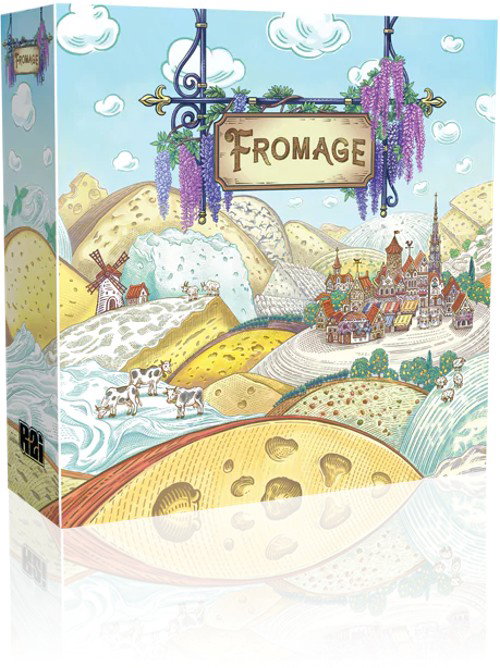


Fromage is a competitive board game designed by Romain Caterdjian and published by Road to Infamy Games. It places each player in the role of a cheesemaker building a French fromagerie in the early twentieth century. Its central setting is cheese production and commerce, not an abstract medieval kingdom or a fantasy world. Players seek prestige by making and selling cheeses, filling orders, and improving their businesses. The game’s French theme is reflected in its fromagerie premise and its focus on ripening cheese before it can meet particular demands. That production cycle gives its worker placement decisions a concrete thematic purpose. Unlike a conventional turn-by-turn worker-placement game, Fromage uses simultaneous play. At the start of a round, every player selects a location available on the side of the shared circular board facing them and commits a worker there. Once everyone has chosen, the board rotates, bringing a new sector to each player while moving their previously assigned workers away. This rotation is the game’s signature system: a worker does not return merely because a round ended; its recovery depends on the board carrying that placement around to its owner. The same rotation also makes planning spatial: players must consider what will face them next. The locations provide different economic purposes rather than repeating one action with new labels. The Fromagerie lets players produce cheeses, whereas the Bistro is associated with completing orders. The Village offers another place to gain benefits, and the Festival creates a public context for scoring and advancement. These areas are arranged as sectors on the rotating board, so their functions cannot be separated from timing. An action’s value is shaped by the resources, cheese state, and opportunities a player expects to encounter after future rotations. That structure creates delayed consequences from every worker commitment, not only immediate gains on offer. Fromage emphasizes foresight because a placement can be useful now while also determining when that worker becomes available again. A player therefore balances an immediate action against the delay imposed by its position on the wheel. The simultaneous selection procedure means players do not wait for a full sequence of individual turns before the board changes; all commitments are resolved before the rotation. By making the board’s orientation part of every decision, Fromage ties cheese making, order fulfillment, and worker availability to one visible, continually changing system. It is this rotating structure that distinguishes its play from ordinary worker-placement games.





Reazioni
0
0 Commenti
Diventa il primo a commentare