
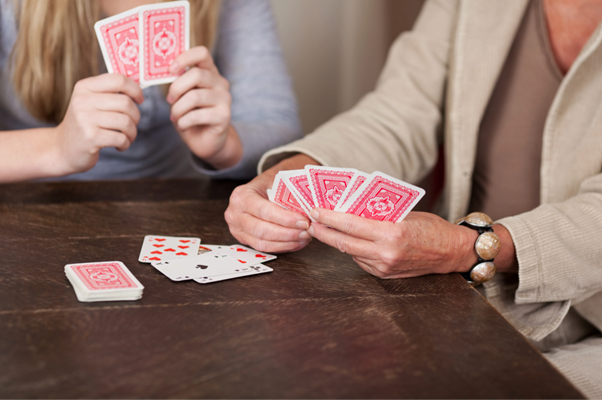










Playing with cards is not limited to the classic Fool. There are many different activities that use one or more decks. Some are designed for family and friends, some belong to professional mind sports, and others fall into the gambling category. In any case, all engaging formats help develop logical thinking, attention, and memory.
We will explore the existing types of these activities, from simple to intellectual and more complex, and highlight the best options for two, three, four, or larger groups. Here you will find the names, key features, and a brief summary of the rules, which will help you make a preliminary choice.
What types of card board games are there?
Cards are good for developing mental processes and helping to relieve stress. Thanks to the large selection, you can find a suitable option for people of different ages, for a pair game or a large group. You may be surprised, but there are also simple card games for children.
Card games can be divided into gambling, commercial, folk and family games:
- Gambling card games. The main feature of gambling formats is the randomness of winning. No special skills or mental abilities are required here — only chance and strategy. An example is poker, which is played in casinos worldwide and often featured on online platforms that offer perks such as a Slotozen casino free chip, giving new players a chance to try the experience without spending their own money. Such competitions take place all over the world.
- Commercial card formats. Preferans is one of the most common commercial options. Here, chance plays no role; skills, abilities and knowledge are what matter. Preferans is a rather complex system that requires strategy and experience.
- Folk and family card activities. These are simple formats with clear rules, designed for relaxation and entertainment. Among the most common are Fool and Drunkard.
All types of card games are also divided by level of complexity into simple, intellectual and complex.
Simple card games
Simple rules, versatility and fun are the main characteristics of simple card games. Depending on the rules, decks of 35 or 52 cards are used. Even if you don't know the rules, they are quite easy to understand and learn. Simple games include all types of fool, underdog, drunkard, pig, checkers and other games. Simple games can be played in pairs or in large groups — it all depends on the rules.
Intellectual card games
These games are just as exciting as standard simple games, but they allow you not only to have fun, but also to show your natural qualities, express yourself, and use your brain. Here are the most interesting and common ones:
Bridge is one of the most popular games overall. The game requires four people and one deck of 52 cards. It is a paired game with two teams — East and West against North and South. The main goal is to play the contract and prevent your opponents from doing so.
Preference is another complex game that is considered commercial. The main focus here is skill and ability. The rules of the game have been developed over many years since the mid-19th century and consist of a combination of various rules from other ancient European games.
King is considered one of the most intellectual games and is aimed more at a female audience. It is the opposite of Preference, so the winner is the one who gets rid of their cards by giving bribes, rather than the other way around.
Deberz — compared to other games, Deberz is relatively young, having appeared in the 1970s. This game combines gambling and commercial elements. It requires two people and one deck of 32 cards.
Intellectual games allow you to develop and maintain good memory, logical thinking, and flexibility, even in old age. So, if you want to stay healthy and keep your mind sharp, it is worth paying attention to intellectual card games.
The most difficult card games
Bridge is considered the most difficult card game. It is over three hundred years old, and there is no game more challenging in the world. When playing Bridge, four people are divided into two teams sitting opposite each other. There are three stages in the game, each of which uses the entire deck of cards. The stages include bidding, the play itself, and scoring.
Interesting card games for two
We have compiled a list of exciting and fairly simple card games for two. However, each of them can also be played by more players. When choosing a game, don't just go by the description of the rules; it's better to try it out, as this is the only way to understand how interesting it is.
Drunkard
The game has become extremely popular in post-Soviet countries. The main task for the players is to collect the entire deck. The game can be played by 2–8 people, and decks of 36, 52, or 54 cards are suitable.
Before starting, a dealer is chosen, who distributes the deck one piece at a time until nothing remains. Players keep their piles face down and do not look at them. The dealer makes the first move by flipping the top item and placing it in the middle. The others follow in turn. Whoever reveals the highest value collects everything on the table and adds it to the bottom of their own stack. After each round, turns continue clockwise. Anyone who runs out of pieces is eliminated, and the winner is the one who gathers the entire deck.
Fool
The rules of this game need no special introduction, as everyone plays Fool, from schoolchildren to pensioners. The game was invented in the nineteenth century. The nobility played Bridge and Preference, while the poorer classes chose Fool.
Fool for two became widespread during the Soviet Union, when variations of the game emerged. It was possible to play not only with a 36-card deck, but also with 52 cards, as well as in Transfer and Throw-Away Fool. The game is suitable for two or a large group, has clear rules, and is quite exciting.
Klabor
This is an analytical game that requires careful consideration of moves, risk-taking, and the ability to fold at the right time. The maximum number of points is 501. Before the game, you need to prepare by drawing a table to record the points scored. The first person to reach the maximum number of points wins.
All ranks lower than 9 are removed from the deck. At the beginning, each participant receives six in hand, along with three laid out on the table. There is a trump, as in Dumb. Each item in the deck has its own value, and certain combinations matter. You can claim victory by the end by collecting the ‘Klabor’ combination.
Chests
Chests can be safely included in the list of easy card games for two. It is aimed at developing logic and intuition. The main task is to guess your opponents' cards to collect the maximum number of fours of the same rank. Standard decks of 36 or 52 cards are suitable. You can play in pairs or in a group of up to six people.
First, the players draw lots to choose the dealer. Then they take turns. Four cards are dealt to each player, and the rest of the deck is placed face down in the centre. Players then ask the dealer questions according to the rules, and play continues clockwise.
‘Ocho’ (or ‘21’)
‘Twenty-one’ (Point, 21) is a popular game with simple rules and an element of luck. A player The dealer is chosen by drawing lots to take the deck and deal one card to each opponent. During play, each participant counts their points, aiming to reach a total of up to 21. If the total goes above 21, the player must announce it, and the dealer wins. If a player reaches exactly 21 points, they win. If both players have fewer than 21 points, the one with the higher total wins. Another situation that results in an automatic win is holding two aces, known as the ‘banker’s point’.
Collectible card games
A Collectible Card Game is a popular genre of board entertainment that brings together strategic play and the enjoyable process of collecting components. Unlike regular tabletop titles, players do not begin with standard basic sets but build their own customised decks. Starter sets are available for newcomers. These starters are suitable for learning and early play, but they are not particularly strong and cannot compete with upgraded or carefully refined decks.
This format gives you the opportunity to shape your deck the way you like, based on your understanding of the rules and your own approach to tactics and long-term strategy. New components are obtained through boosters, which are random packs containing items of various levels of rarity. No one knows what will appear in a booster, and this element of unpredictability keeps the collecting experience exciting. With boosters, players can strengthen their decks and expand their collections over time.
If you have become interested in trying this collectible format and would like to begin building a collection, you can take the next step easily. If the price suits you, you may order the set you have selected through quick order, or log into your account and complete the purchase using your accumulated discount. Delivery will arrive promptly.
Card board games
Although card decks have much in common with other board games, they are usually placed in their own separate category. They offer entertainment and also stimulate mental activity.
Regular card battles among adults help train memory. They encourage social interaction. They can reduce feelings of depression, prevent boredom and keep the brain occupied with something meaningful. There are no studies proving that they prevent neurodegenerative diseases such as Alzheimer’s. However, people who regularly and enthusiastically try to outplay their opponents in card games significantly increase their mental activity. This, in turn, may help delay the onset of sclerosis-related symptoms.



 ログインして会話に参加する
— コメント 0
, 反応 1
最初にコメントする